How Does Advanced AI Price Intelligence Improve Pricing Decisions for Retailers?
From spreadsheets to real-time signals: what retail pricing teams are actually gaining from AI-driven product matching, elasticity modeling, and governed automation in 2026.

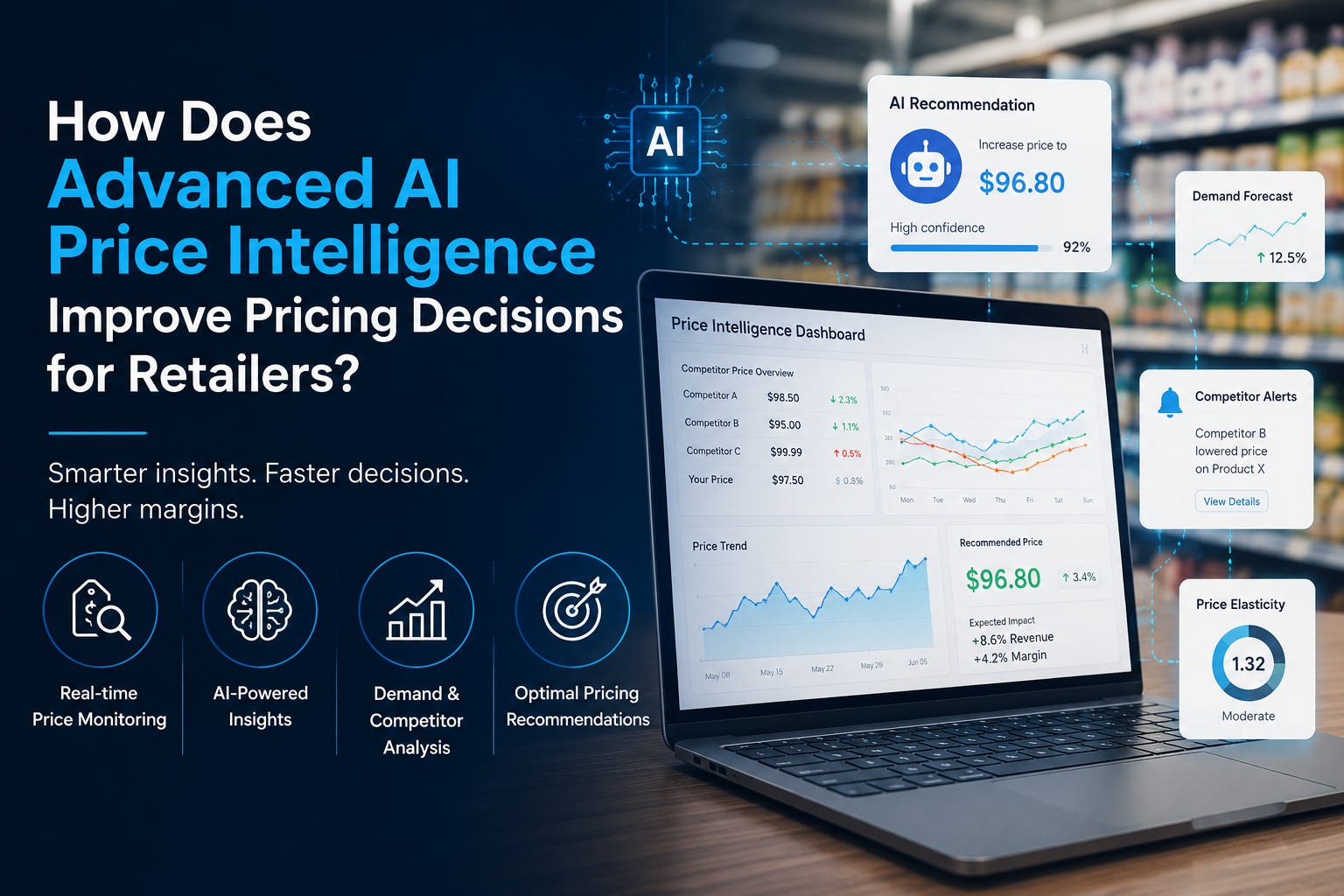
Pricing used to be a quarterly exercise. A category manager would pull out a spreadsheet, check a handful of competitor prices manually, apply a margin rule, and move on until the next review cycle. That approach worked when shelf prices changed a few times a season, and competitors were limited to a handful of nearby stores.
That world is gone. Retail pricing has become a real-time discipline, with assortments expanding, promotional calendars compressing, and marketplaces publishing competitor prices by the minute while shoppers compare offers from their phones. A pricing team built around a spreadsheet, and a quarterly review simply cannot keep pace with a market that moves hour by hour.
This is the gap that advanced AI price intelligence is built to close. Rather than replacing human judgment, it gives pricing teams a continuously updated, machine-verified picture of the market, then layers prediction and automation on top of that picture, so decisions can be made faster and with more confidence. Below is a practical look at how that shift is changing the way retailers set prices, grounded in current industry data, established pricing theory, and a few original examples that illustrate the mechanics.
What Makes AI Price Intelligence Different from Traditional Price Tracking?
Traditional price tracking sort of only answers one thing: what is my competitor charging right now? But Advanced AI price intelligence goes way beyond that, it asks a whole bigger bunch of questions, like which of my SKUs are actually comparable to theirs, how has the price moved over the last 90 days, and what happens to my conversion rate if I match it. It also tries to tell me the safest price I can set, without triggering a margin problem three weeks from now, even if the market gets a bit weird.
The difference comes down to three capabilities that weren’t practical at scale before machine learning matured:
Product matching at scale
Comparing a retailer’s catalog against thousands of competitor listings used to require manual SKU mapping, which broke down the moment product titles, bundle sizes, or variant descriptions diverged even slightly. AI-driven matching models now read product attributes, images, and specifications together to identify true equivalents across catalogs, even when listings are worded differently.
Elasticity and demand modeling
Instead of assuming that lowering price always increases volume, modern systems model how sensitive each product category actually is to price changes, factoring in seasonality, inventory position, and historical response patterns.
Governed automation
The pricing decision itself can now be partially or fully automated within rules the retailer sets, rather than requiring a human to manually adjust each price after reviewing a report.
What Industry Trends Are Shaping Pricing Decisions Right Now?
A few patterns are showing consistently across market research this year, and they matter because they explain why advanced AI price intelligence has moved from “nice to have” to core infrastructure for pricing teams.
Real-time pricing is becoming the default, not the exception. Industry forecasts suggest more than 70% of European retailers may be operating with real-time automated pricing by the end of 2026. That is a meaningful shift from even two or three years ago, when automated repricing was mostly confined to marketplace sellers rather than full-line retailers.
Margin protection has become as important as price matching. Deloitte’s research indicates that 73% of retailers plan to gradually raise prices in 2026, while 72% intend to shift their product mix toward higher-margin or value-added items. This tells you something important: AI price intelligence isn’t only being used to chase the lowest price anymore. It’s increasingly used to identify where a retailer has room to hold or raise prices without losing the sale.
Blanket pricing strategies are losing ground. Treating every product with the same pricing logic no longer meets market needs, since some items can command higher margins because of brand equity or timing, while others need aggressive positioning to protect volume and market share. This is a direct consequence of better data. Once a retailer can see elasticity at the individual SKU level, applying one blanket markup or markdown rule across an entire category starts to look like leaving money on the table in some places and losing sales in others.
Agentic AI is starting to influence the buying side, not just the pricing side. As AI shopping agents begin influencing purchasing decisions, retailers now need to think about how their product data and pricing logic will be interpreted by machines, not just by human shoppers. This is a genuine new consideration. A price that reads clearly to a person browsing a website may need to be structured differently for an AI agent comparing offers programmatically on a customer’s behalf.
How Are Classic Pricing Frameworks Changing Under AI?
Pricing theory hasn’t been thrown out. What’s changed is how quickly and how granularly these frameworks can be applied.
Cost-plus pricing is still the foundation for many categories, especially where margin floors are non-negotiable. What AI adds here is speed. When input costs shift, whether from currency movement, freight, or supplier price changes, an AI system can recalculate the floor price across thousands of SKUs immediately rather than waiting for a manual repricing cycle.
Competitive-based pricing is the most visibly transformed area. Historically this meant checking out a short list of named rivals occasionally. With continuous tracking across tens of thousands of retailers and marketplaces, a pricing team can see not just where they’re positioned versus a few competitors, but where they’re positioned across the whole product category, refreshed multiple times a day.
Value-based pricing benefits AI in a less obvious but arguably more important way. By combining elasticity modeling with product attribute data, retailers can identify which SKUs customers treat as commodities (where price matching matters most) versus which ones carry genuine differentiation (where price can hold firmer). A private-label kitchen appliance and a branded one with a loyal following should rarely be priced using the same logic, even if they sit in the same category.
Dynamic pricing, back when it was controversial because of worries about unpredictable or kind of opaque price swings, has sort of matured into this more “governed” version. Instead of letting an algorithm move price freely, most big enterprise setups now work within rule libraries… like minimum margin floors, brand-relationship guardrails, and override authority for category managers. This turns toward governance matters, mainly because it hits the earlier criticism head on. That algorithmic pricing was a black box, you know, no real visibility and all that.
What Does This Look Like in Practice?
Here’s an illustrative example that shows how these pieces fit together. Imagine a mid-size home goods retailer selling a set of ceramic dinnerware across its own site and three major marketplaces. Without price intelligence, the pricing team might check a competitor’s listing once a week, notice a price drop, and manually adjust to match, often days after the change actually happened and without knowing whether the competitor’s version even included the same number of place settings.
With AI-driven product matching, the system first confirms whether the competitor’s listing is actually the same product, not just a similarly named one. If a competitor’s set has four fewer pieces, matching the sticker price would actually undercut on a per-unit basis, a mistake that’s easy to make manually and easy to avoid with attribute-level matching. From there, elasticity modeling might show that this product responds only weakly to small price differences, because customers are buying it for aesthetic reasons rather than pure price comparison. That insight alone can justify holding a slightly higher price than a competitor rather than automatically matching it, protecting margin without hurting conversion.
This kind of decision, informed by matched product data and elasticity rather than a same-day competitor’s snapshot, is the practical difference between reactive pricing and intelligent pricing.
What Are Marketplaces Adding to the Picture?
Marketplaces deserve their own mention because they’ve become a pricing signal in their own right. Buy Box dynamics on major marketplaces, MAP (Minimum Advertised Price) compliance across resellers, and stock-level visibility all feed into pricing decisions that go beyond simple price comparison.
A retailer that only tracks price without tracking stock availability can end up matching a competitor’s price on an item that competitor barely has in stock, which is a poor use of margin. Conversely, understanding when a retailer has won or lost Buy Box position on a marketplace gives pricing teams a much more direct signal of competitiveness than price alone, since Buy Box outcomes reflect price, fulfillment speed, and seller reputation together.
MAP compliance monitoring has also grown in importance as brands sell through more third-party resellers. Detecting violations in near real time protects brand pricing integrity across channels that a manual review process would likely miss for weeks.
What Are Experts Saying About Where This Is Heading?
McKinsey researchers frame the shift less as a question of where AI can be used, and more as a question of which pricing decisions can safely be delegated to automated systems, based on whether those decisions have clear rules, auditability, and reversibility (McKinsey, “B2B pricing: Navigating the next phase of the AI revolution,” April 2026). Where those conditions don’t yet hold, generative AI still adds value by giving pricing teams faster analysis and better explanations, helping them act with more confidence even when a human is making the final call. That framing is a useful mental model for any retailer evaluating how much of their pricing process to automate, and it echoes a related McKinsey piece on the automation curve in agentic commerce, which lays out the same rules-auditability-reversibility test for deciding what to hand off to AI. The practical starting point: begin with decisions that are rule-based and reversible and keep human oversight on the ones that involve brand strategy or exceptions.
Adoption data backs up how quickly this is moving. Roughly 31% of enterprises are now running at least one AI agent in production, with ecommerce and retail among the sectors actively deploying them, though returns remain uneven across organizations. That unevenness is worth sitting with. The retailers seeing real returns tend to be the ones that combine good underlying data (accurate product matching, clean competitor feeds) with disciplined governance, rather than the ones simply turning on automation and hoping for the best.
The Practical Takeaway
Advanced AI price intelligence doesn’t remove the need for pricing strategy. It removes the lag between what’s happening in the market and when a retailer finds out about it, and it removes the manual grunt work of matching products and calculating elasticity across thousands of SKUs. What’s left for the pricing team is the part that requires judgment: deciding which categories deserve aggressive competitive matching, which deserves room to protect margin, and where the line sits between the two. That judgment call is still human. What’s changed is how well-informed it can be by the time it’s made.